Moonly: Moon Phases & Calendar
- 3.9
- Rating
- 1.00M
- Installs
- Free
- Price
 Analysis by App-foxy
I spent time with Moonly: Moon Phases & Calendar as a lifestyle app built around one central idea: using lunar cycles as a recurring prompt for reflection. Instead of treating astrology as a one-time personality reading, it places the moon, a birth chart, meditations, affirmations, and mental-health-oriented routines in the same space. That combination makes it feel more like a daily self-check tool than a simple moon calendar.
My first impression was that the app is easiest to understand when I use it as a gentle planning ritual. I can look at the current lunar context, read an astrology-oriented interpretation, and then move into a short reflective activity. The value is not in proving that the moon controls my mood. The value is in having a repeatable moment that encourages me to pause, name what I am feeling, and decide what deserves attention.
That distinction matters. If you want an astronomy app with precise observational information, this is not the direction I would choose. If you enjoy symbolic routines and want a convenient place for moon phases, birth-chart material, affirmations, and meditation, the approach is much more appealing. I found the app most useful when I treated its guidance as a prompt rather than an instruction.
You May Also Like

 Blood Strike: 2.5 Anniversary
Blood Strike’s Loadouts Turn Every Drop Into a Tactical Gamble
A close look at Blood Strike’s custom loadouts: how fast access to signature weapons reshapes its battle royale rhythm, rewards preparation, and narrows the gap between fights.

 Pandora - Music & Podcasts
Pandora’s Music Is Easy to Start, but Harder to Recover
Pandora’s strength is its low-effort path from a seed to a station. Its weak spot is how much confidence it asks you to place in connection, setup, and quiet recovery.

 8 Ball Pool
 Is Built on Rivalries, Rematches, and Routine
A close look at the rivalries, rematches, shared routines, and unanswered safety questions that turn a quick pool match into a persistent mobile community.

 Samsung Music
’s Quiet Strength Is Playing What You Already Own
Its reach comes less from spectacle than from dependable access to a personal library. That simplicity is both the app’s strongest retention engine and its ceiling.

 AccuWeather: Weather Radar
AccuWeather Review: A Quick, Clear Forecast for Everyday Decisions
For everyday plans, the best forecast is the one you can understand quickly. AccuWeather makes rain timing, radar, and local conditions easy to act on, with a few trade-offs.

 Hill Climb Racing
Why Hill Climb Racing Still Turns Crashes Into One More Run
A tiny car, a bumpy hill and one more upgrade: Hill Climb Racing keeps resurfacing because its simple chaos makes every near-miss feel personal.
More From Our News Desk



How the lunar focus changes everyday use
The strongest capability here is the way lunar cycles give the rest of the experience a rhythm. A meditation app can ask me to relax at any time, and a horoscope app can offer a reading for the day. Moonly connects those ideas to a changing cycle, which gives a session a little more context. I am not simply opening another list of wellness exercises; I am checking in with a theme that changes over time.
In practice, this can make a short session feel more intentional. I might open the app in the morning, review the lunar information, and choose an affirmation that matches the kind of day I expect to have. On a stressful evening, I can reverse that order: start with a calming exercise, then use the astrology material as a way to think about what has been occupying my mind. The flexibility is more useful than a rigid routine because I do not always need the same kind of support.
The birth-chart side gives the experience a more personal entry point. Rather than reading only a general statement intended for everyone, I can explore material connected with my own astrological profile. That does not make every interpretation automatically accurate, but it does make the app feel less interchangeable with a basic daily horoscope. For readers who already understand their chart, this personal layer may be the reason to return.
I also appreciated that the app does not force me to approach it as a serious spiritual commitment. I can use a meditation without accepting every astrological claim, or read a lunar interpretation without completing an affirmation. That separation is important for people who are curious but cautious. The app works best when I decide which parts are meaningful to me instead of allowing the app to define the meaning of every event.
Its mental-health framing deserves a careful explanation. The meditations and affirmations can support a personal wellness routine, especially when I use them to slow down or organize my thoughts. They should not replace professional care, diagnosis, or urgent help. I see them as lightweight tools for reflection, not treatment. That boundary makes the app more responsible to use and prevents the lunar language from becoming an excuse to ignore a serious problem.
What a useful session looks like
A practical workflow is to begin with observation rather than interpretation. I first look at the lunar information, then ask myself what I am actually experiencing before reading a longer explanation. This small habit prevents the text from deciding my mood for me. After that, I choose one meditation or affirmation and write down a single action for the day, such as having a difficult conversation, taking a proper break, or finishing a task I have been avoiding.
That workflow is one of the less obvious strengths of the app. Many people will open an astrology tool hoping for a clear answer, but I got more from it when I used the content to create a question. “What should I do?” became “What am I noticing, and what would help?” The lunar cycle supplies the prompt; I supply the judgment.
Another useful approach is to avoid opening every section in one sitting. The combination of birth-chart information, lunar material, meditations, and affirmations can become mentally busy. I get a better experience when I select one purpose before opening the app. For example, I use the birth chart when I want personal context, the moon section when I want a cycle-based check-in, and the meditation material when I need to settle down. This keeps the experience from turning into endless scrolling.
The app is free to install and is suitable for Everyone, which lowers the barrier to trying it. It runs on Android devices using version 6.0 or later. Cosmic Vibrations Inc is the developer, and the current version is 1.0.319. Those details make it accessible to people using older supported phones, although the quality of the experience will still depend on the device and how comfortable the interface feels on its screen.
A realistic evening routine
Imagine finishing work with a crowded head and no desire to start a complicated wellness program. I would open the app, check the lunar section, and spend a few minutes reading rather than trying to absorb everything. I would then choose one affirmation that feels practical instead of overly grand. If I still felt tense, I would move to a meditation and leave the rest of the content for another day.
The important part of that routine is its modest size. I do not need to turn it into a ceremony or spend a long time comparing interpretations. The app is most convincing when it helps me create a small pause between the day’s pressure and the next decision. If I finish by identifying one concrete next step, the session has done something useful even if I do not agree with every astrological explanation.
For someone who already keeps a journal, the app can act as a prompt generator. I can record the lunar phase, note the feeling it brings up, and compare that note with what actually happened later. This is a better way to test whether the app’s language helps me than simply accepting a prediction. Over time, the journal becomes my evidence, while the app remains a source of themes and questions.
Where the experience feels limited
The same lunar focus that gives Moonly its identity can also narrow its appeal. If I want a straightforward calendar, task planner, or evidence-based mental-health program, I would look elsewhere. The app’s language is interpretive and spiritual, so users who prefer measurable goals or clinically structured exercises may find it vague. That is not a flaw in every context, but it is a real mismatch for people seeking direct, practical instruction.
I also had to manage the temptation to read too much into the content. Astrology can feel personal, especially when it is connected to a birth chart, but personal wording is not the same as personal certainty. I would be uncomfortable using any recommendation here to make a major health, financial, or relationship decision. The app is better at helping me frame a reflection than at telling me what choice is objectively correct.
There is also a possible attention problem. A wellness app that includes several related areas can encourage browsing when I intended to take a short break. For me, the fix was to enter with a specific limit: one lunar reading, one affirmation, or one meditation. Without that boundary, the experience can shift from calming to absorbing, particularly for users who enjoy astrology and want to explore every layer of their chart.
Moonly is free, but it includes optional in-app purchases ranging from $0.99 to $99.99 per item. That wide range means I would pay close attention to the purchase screen before committing to anything. The free starting point is useful for judging whether the tone, interpretations, and wellness exercises suit me. I would not buy simply because a reading sounds personally relevant; I would first confirm that the added material fits a routine I will actually maintain.
The public response suggests a mixed but substantial audience: the app has an average rating of 3.9 from around 29 thousand ratings, along with roughly 2.3 thousand written reviews and over a million installs. I read that as a sign of broad interest rather than a guarantee of satisfaction. A rating in this range tells me that the concept works well for some people while others likely encounter differences in expectations, interpretation, or app experience.
Another trade-off is the balance between convenience and depth. Having lunar cycles, chart material, meditations, and affirmations together is convenient, but a dedicated meditation app may offer a more focused wellness experience, while a dedicated astrology service may provide deeper chart analysis. Moonly makes more sense when I value the connection between these areas. It is less compelling if I want the strongest specialized tool in only one of them.
Who gets the most from it
I would recommend this app to someone who enjoys astrology but wants to make it part of an everyday routine rather than reading an occasional horoscope. It is also a good fit for a curious beginner who wants to explore lunar cycles and birth-chart ideas without immediately building a complicated system of their own. The guided structure gives that person a place to start, while the free access makes experimentation easier.
It can also suit people who already meditate but struggle to begin consistently. The lunar theme supplies a reason to open the app, and the affirmation can make the first minute feel less demanding. I would not describe it as a replacement for a dedicated meditation library, but it can be a helpful bridge for someone who needs a small ritual before a longer practice becomes natural.
People who enjoy journaling may find an especially good use case. I can use the moon phase as a recurring label, the birth-chart content as a personal prompt, and the meditation as a way to settle before writing. The benefit is not that the app predicts my inner life; it is that it gives me a consistent structure for noticing patterns. That makes the experience more valuable when I actively reflect instead of passively consuming readings.
I would suggest skipping it if you want astronomy-first information, a conventional calendar, or mental-health guidance designed by a clinical service. I would also be cautious if spiritual interpretations tend to increase your anxiety or make you feel controlled by outside forces. In that situation, a neutral journaling app, a focused mindfulness tool, or professional support would be a better choice.
The age rating of Everyone makes the app approachable for a broad audience, but suitability is still personal. Younger users may need help understanding that affirmations and astrology are reflective content, not guaranteed predictions or medical advice. Adults should apply the same common sense, especially when the app’s language feels unusually precise or emotionally persuasive.
My recommendation after using it
The best way to use Moonly is as a reflection companion, not an authority. When I keep that boundary, the app’s central capability becomes genuinely useful: the lunar cycle gives me a recurring reason to pause, and the connected chart, meditation, and affirmation tools help me decide how to use that pause. The experience feels more personal than a plain moon calendar and less demanding than a formal wellness program.
I would start with the free experience and test one simple routine for several days: check the lunar information, choose one prompt, and finish with one practical action. If that process helps you slow down without making you dependent on predictions, the app may earn a place in your daily habits. If you find yourself searching for certainty, repeatedly buying content, or treating interpretations as instructions, I would step back.
Overall, Moonly: Moon Phases & Calendar is a thoughtful lifestyle app for people who like symbolic structure and gentle self-reflection. Its strongest feature is not any single reading or meditation; it is the way the changing moon can turn scattered wellness tools into a recurring personal check-in. I recommend it to curious, self-directed users who can enjoy that framework while keeping their own judgment firmly in charge.
FAQs for Moonly: Moon Phases & Calendar
01What is Moonly: Moon Phases & Calendar used for?
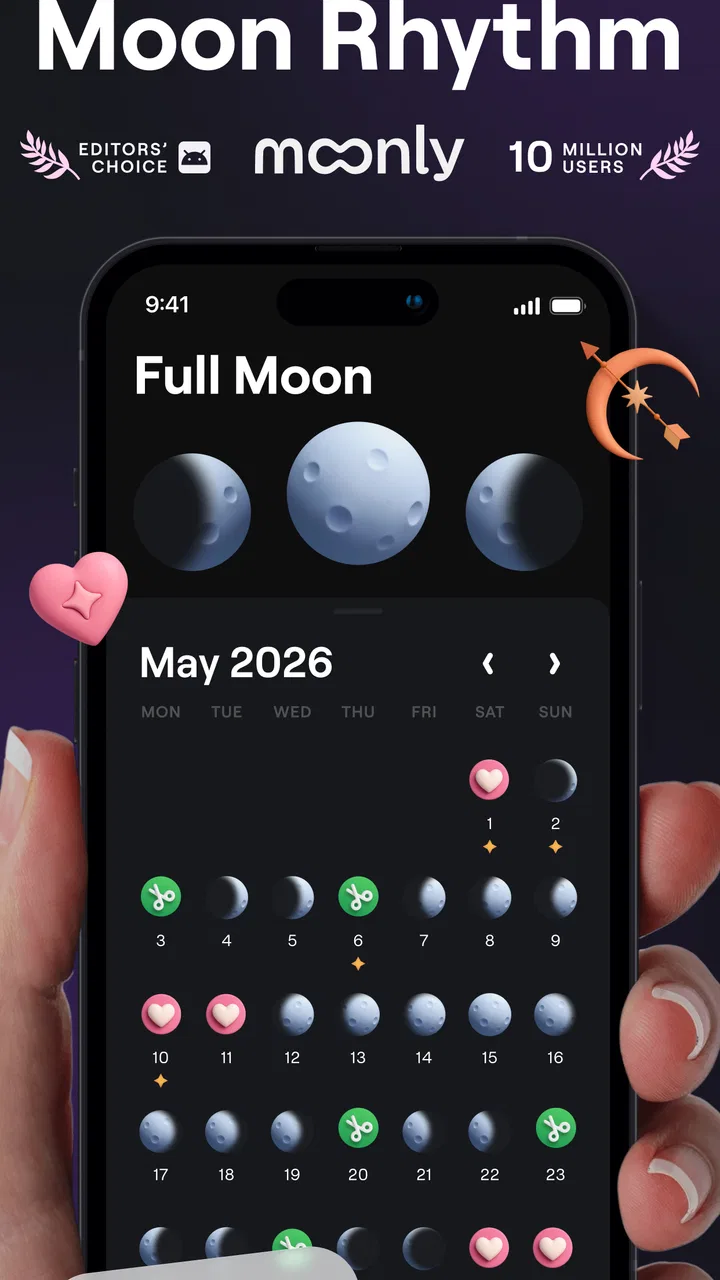
Moonly: Moon Phases & Calendar is designed to help users follow the lunar cycle in a clear, visual way. It typically provides information about current and upcoming moon phases, moonrise and moonset times, lunar dates, and calendar views. It can be useful for casual skywatchers, photographers, gardeners, travelers, or anyone who enjoys planning activities around the Moon.
02Does Moonly provide accurate moon phase and moonrise information?
The app’s calculations are generally based on astronomical data and your selected location, so accuracy depends on entering the correct city or allowing location access. Moonrise, moonset, and phase times may vary slightly from official observatories because of calculation methods, elevation, time-zone settings, and local horizon conditions. For professional astronomy, users should compare the information with a trusted observatory or weather service.
03Does Moonly: Moon Phases & Calendar require an internet connection?
Many basic calendar and moon-phase features may remain available after the relevant data has loaded, but some functions can depend on an internet connection. Location searches, synchronization, advertisements, subscription checks, updates, and additional content may not work offline. If you plan to use the app while traveling or outdoors, it is sensible to open it beforehand and verify that the required dates and location data are available.
04Is Moonly free to download, and are there in-app purchases?
Moonly: Moon Phases & Calendar may be available as a free download, but the exact features included without payment can depend on the current version and platform. Some editions may contain advertising or offer premium tools through in-app purchases or a subscription, such as extended forecasts, extra calendar details, widgets, or customization options. Check the store listing and subscription terms before confirming payment.
05Does Moonly collect my location or personal information?
The app may request location access so it can calculate local moonrise, moonset, and lunar event times. You can usually deny permission and enter a location manually, although some location-based features may become less convenient or less precise. Before installing, review the Google Play or App Store privacy section for the current developer disclosures, data practices, retention details, and any information shared with third parties.
Pros
- Clear moon-phase visuals make the lunar cycle easy to understand.
- Personalized lunar calendars help plan rituals
- journaling
- or outdoor activities.
- Includes astrology and numerology content beyond basic moon tracking.
- Notifications can remind users about upcoming phases and lunar events.
- Calm design and reflective content create a relaxing daily-use experience.
Cons
- Many advanced readings and practices require a paid subscription.
- Some interpretations may feel too general for experienced astrology users.
- The amount of spiritual content can feel overwhelming for casual users.
- Certain features may depend on an internet connection to load content.
- Privacy-conscious users may dislike account or tracking requirements for personalization.

Moonly: Moon Phases & Calendar
Gallery